Longacres Finance
The Snowball Effect: How Dividend Reinvestment Builds Wealth
Dividend reinvestment is one of the simplest, and most powerful, ways to build long-term wealth. Learn how compounding, dividend growth, and consistent investing create a snowball effect that can transform modest investments into a growing stream of passive income over decades.
"The first dollar of passive income is the hardest. Every dollar after that gets a little easier."
One of the greatest advantages long-term investors have isn't the ability to predict the next market winner or perfectly time every correction. It's the simple decision to reinvest every dividend they receive.
Dividend reinvestment transforms your portfolio from a collection of investments into a machine that continuously builds itself. Every dividend buys additional shares, those new shares generate their own dividends, and those dividends purchase even more shares.
Over time, this self-reinforcing cycle accelerates, turning steady savings into an increasingly powerful stream of passive income.
This is the snowball effect, and it's one of the most reliable ways to build long-term wealth.
What Is Dividend Reinvestment?
Whenever a company pays a dividend, investors have two options. They can take the cash and spend it, or they can use those dividends to purchase additional shares of the same company.
Choosing the second option means every future dividend is calculated on a slightly larger ownership stake. Those extra shares begin producing dividends of their own, which are reinvested into even more shares. Each payment increases the portfolio's future earning power without requiring additional effort from the investor.
Rather than simply collecting income, you're continuously expanding the engine that produces that income.
Understanding the Snowball
Imagine rolling a small snowball down a hill. At first, it barely changes size. With each rotation, however, it picks up more snow. As it grows larger, every rotation collects even more than the last. By the time it reaches the bottom, the snowball bears little resemblance to where it started.
Dividend investing follows the same pattern.
The early years can feel underwhelming. A $25 quarterly dividend may only purchase a fraction of a share. A year later that payment might grow to $30, then $40, then $60. The progress appears incremental.
Fast forward a decade or two, however, and those same quarterly payments may have grown into hundreds or even thousands of dollars. Every payment purchases substantially more shares than the one before it, causing future dividend income to accelerate even further.
The remarkable part isn't how quickly the snowball grows at the beginning. It's how dramatically it grows once compounding has had enough time to work.
Compounding: Your Greatest Investing Advantage
Albert Einstein is often credited with calling compound interest the eighth wonder of the world. Whether he actually said those words is debatable, but the underlying principle remains one of the most powerful forces in finance.
Dividend investors benefit from multiple layers of compounding working simultaneously. Companies grow their earnings, which often leads to higher share prices. Many high-quality businesses also increase their dividends year after year. Reinvested dividends purchase additional shares, and those shares generate even more dividend income.
Each of these layers reinforces the others. The longer the process continues, the more difficult it becomes to distinguish how much of your portfolio came from your own contributions and how much was created through compounding alone.
Why Time Matters More Than Size
Many new investors believe they need a large portfolio before dividend investing becomes worthwhile. In reality, time is far more valuable than starting capital.
Consider two investors. One begins investing $300 per month at age 25, while another waits until age 35 and invests significantly more each month. Despite contributing less money early on, the first investor often finishes with substantially greater wealth simply because their investments had an additional decade to compound.
Every year your portfolio remains invested gives your dividends another opportunity to purchase more shares. Those shares generate larger dividends, which buy even more shares. Time allows this cycle to repeat hundreds of times over a lifetime, and each repetition increases the speed at which your income grows.
Dividend Growth Supercharges Reinvestment
Dividend reinvestment becomes even more powerful when paired with companies that consistently raise their dividends.
Imagine owning 100 shares of a business that pays $2.00 per share today. Over the next decade, management steadily increases that dividend to more than $4.00 per share.
Even if you never purchased another share yourself, your annual dividend income would more than double.
Now add dividend reinvestment to the equation.
Each dividend increase provides more cash to reinvest. Those reinvested dividends purchase additional shares, and every new share begins receiving the larger dividend payment as well. Instead of one source of growth, you now have two powerful forces working together: a growing business and an expanding ownership stake.
This combination is what separates exceptional long-term dividend portfolios from average ones.
A Simple Example
Suppose you invest $10,000 into a diversified portfolio yielding 3%, and the companies increase their dividends by an average of 8% annually. You reinvest every dividend and never contribute another dollar.
During the first year, your portfolio produces roughly $300 in dividend income. On its own, that may not seem particularly exciting.
Ten years later, however, your annual dividend income could easily approach $700 to $800 depending on dividend growth and market conditions. After twenty years, that figure may exceed $1,500 annually. By year thirty, your portfolio could be generating well over $3,000 every year in passive income, all from the original $10,000 investment and decades of reinvestment.
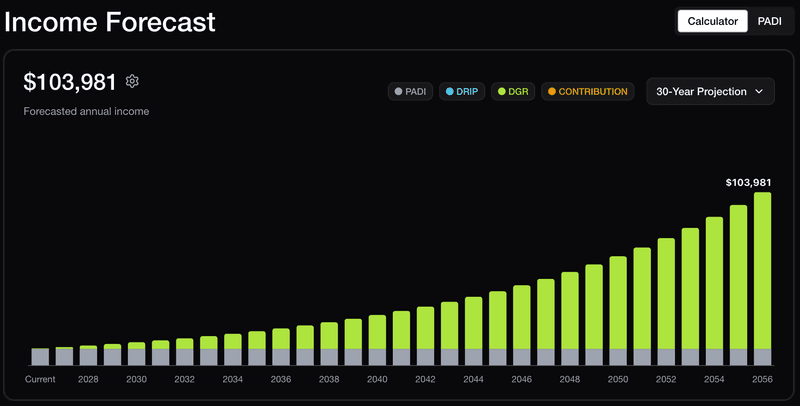
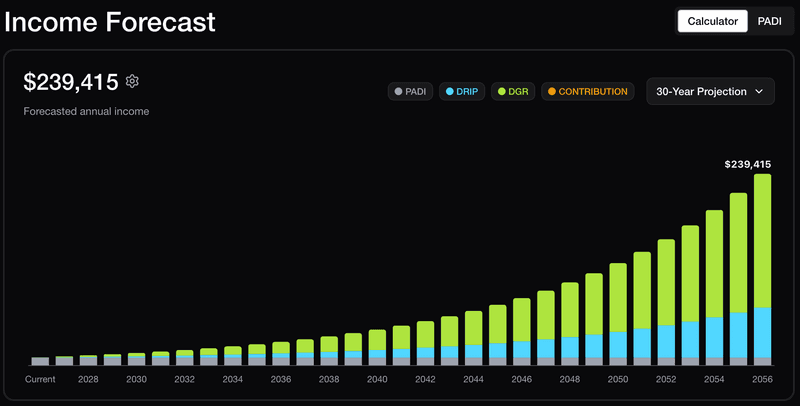
It's one thing to understand compounding in theory. It's another to see how dramatically dividend reinvestment changes your future income. Below is a simple forecast comparing a portfolio that reinvests every dividend with one that doesn't.
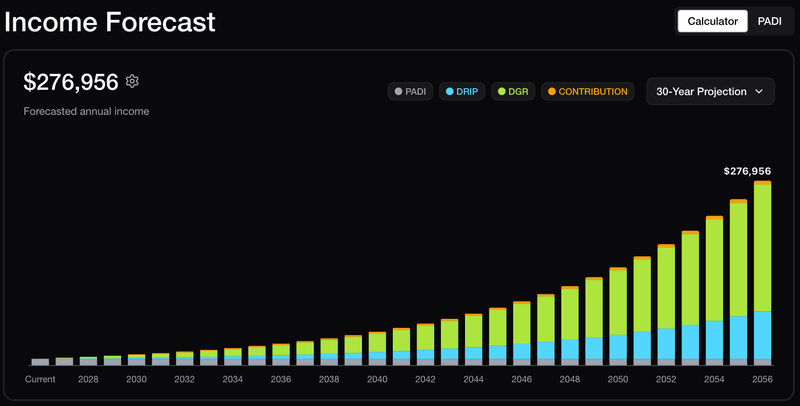
Now imagine that instead of stopping after the initial investment, you also contributed $500 every month.
Over ten years, your portfolio might already be producing several thousand dollars in annual dividend income. After twenty years, that income could grow into the five figures.
Continue the same disciplined approach for thirty years, and it's no longer unrealistic to generate $30,000, $50,000, or even more in annual dividends depending on market returns, dividend growth, and your investment choices.
At that point, your dividends are no longer just supplementing your savings, they're becoming a meaningful source of passive income capable of paying for vacations, covering major household expenses, or helping fund retirement without selling your investments.
This is why experienced dividend investors focus on decades instead of quarters. The most significant growth often occurs in the later years, after compounding has had sufficient time to build momentum.
Why Consistent Contributions Matter
Dividend reinvestment is incredibly powerful on its own, but regular contributions make the snowball grow even faster.
Think of reinvested dividends as adding snow to the snowball naturally. Every monthly contribution gives it another push downhill.
Whether you're investing $100, $250, or $500 each month is less important than maintaining consistency.
Consistency can have an even bigger impact than trying to find the perfect stock. Combining monthly contributions with dividend reinvestment allows the snowball to grow from two directions: new savings and compounding income.
Investors who continue purchasing shares through bull markets and bear markets alike often build substantially larger portfolios than those who try to wait for the perfect opportunity.
The habit of investing consistently is frequently more important than finding the perfect investment.
The Psychological Advantage
Dividend reinvestment also changes the way long-term investors view market volatility.
When stock prices decline, many investors become anxious because they focus on falling account balances. Dividend investors often see something different.
Lower share prices allow every reinvested dividend to purchase more shares. Those additional shares can produce even larger dividend payments once markets recover. Instead of viewing market corrections solely as losses, disciplined dividend investors often recognize them as periods when the snowball gathers the most snow.
Maintaining that long-term perspective can make it much easier to stay invested during difficult markets.
Choosing Companies Built for the Long Run
The snowball effect works best when the underlying businesses continue growing for decades.
High-quality dividend companies typically exhibit strong free cash flow, conservative payout ratios, healthy balance sheets, durable competitive advantages, consistent earnings growth, and a long history of increasing dividends. These characteristics improve the likelihood that future dividend increases will continue, allowing the compounding process to remain intact.
A growing dividend stream is ultimately what keeps the snowball rolling downhill.
When Should You Stop Reinvesting?
For most investors, automatic dividend reinvestment makes sense throughout the accumulation phase.
Eventually, however, the goal changes.
Rather than purchasing additional shares, many retirees begin receiving their dividends in cash to help fund everyday living expenses. Instead of selling assets to create income, the portfolio itself provides a stream of cash flow while the underlying shares remain invested.
This flexibility is one of dividend investing's greatest strengths. The same portfolio that spent decades building wealth can naturally transition into producing retirement income.
Common Mistakes to Avoid
The biggest mistakes dividend investors make are usually behavioral rather than analytical.
Chasing unusually high dividend yields often leads investors into financially weak businesses with unsustainable payouts. Ignoring valuation can reduce future returns even when investing in excellent companies. Pausing investments during bear markets prevents investors from purchasing shares when they're most attractively priced.
Perhaps the most common mistake, however, is expecting meaningful results too quickly.
The first five years of dividend investing often feel slow. The next ten become noticeably more rewarding. The final decade is where compounding frequently does its best work.
Patience isn't simply a virtue for dividend investors, it's one of the primary drivers of long-term returns.
The Yieldr Perspective
Dividend reinvestment becomes even more effective when you can clearly see where your income is heading.
That's why Yieldr goes beyond simply tracking dividend payments. By monitoring metrics such as Projected Annual Dividend Income (PADI), dividend growth rates, portfolio yield, dividend safety, free cash flow, and overall portfolio quality, investors can better understand how today's decisions may influence their future income.
Watching projected dividend income grow year after year makes the benefits of compounding tangible and helps investors remain committed during periods of market volatility.
Final Thoughts
Dividend reinvestment doesn't create wealth overnight. It creates wealth quietly, consistently, and almost invisibly.
Every reinvested dividend increases your ownership. Every additional share produces more income. Every dividend increase strengthens the cycle further.
At first, the progress feels almost insignificant. Then, almost without noticing, your portfolio begins producing enough income to cover small expenses. Eventually it may pay for a vacation, a monthly mortgage payment, or an entire year's property taxes. Given enough time, it can grow into an income stream capable of replacing a meaningful portion of your salary, or even funding retirement itself.
That's the beauty of the snowball effect.
The hardest part is building the first handful of snow.
Once the snowball has enough momentum, compounding begins doing more of the work than you ever could on your own.
Track your dividend snowball with the help of Yieldr.