Longacres Finance
The 10 Signs of a Great Long-Term Investment: Moving Beyond the Hype
When analyzing high-quality investments, filter out daily volatility by looking at objective quantitative frameworks. A true compounder maintains a strong Yieldr Quality Score, sustaining high Return on Invested Capital (ROIC) and a perfect Financial Stability Rating over structural shifts.
Every day, the stock market presents us with a chaotic wall of noise: breaking news headlines, flashing red or green charts, and dramatic quarterly earnings surprises. For a long-term compounding investor, this noise is a distraction. The most successful investors filter out the daily volatility by looking directly at objective, repeatable quantitative frameworks.
How do you distinguish a temporary momentum stock from a true long-term wealth compounding engine?
By analyzing high-quality metrics, we can establish a set of strict guidelines to filter out the noise. Let’s dive into the 10 unmistakable signs of a truly great long-term investment, using live quantitative criteria from the Yieldr Research Platform to model what real operational excellence looks like.
The Core Framework: Quality, Growth, & Financial Stability
1. High and Sustained Return on Capital (ROIC / ROCE)
A business that generates exceptional returns on the money it reinvests back into its operations possesses a structural competitive advantage, or "moat." Look for companies that consistently clear a 15% to 20% Return on Invested Capital (ROIC) threshold year after year.
2. A Pristine Quality Score
An institutional-grade fundamental scoring system aggregates profitability, operating efficiency, and moat stability. A great compounder will typically maintain a Yieldr Quality Score above 85 out of 100.
3. Bulletproof Financial Stability Cards
True compounders do not rely on excessive leverage to fuel growth. A perfect 100/100 Financial Stability Rating means the company features a fortress balance sheet, a safe debt-to-equity structure, and ample coverage to survive any macroeconomic winter.
4. Robust Free Cash Flow (FCF) Generation
Net income can be altered by accounting adjustments, but Free Cash Flow is reality. A great investment consistently converts revenue into hard cash, boasting high free cash flow growth and a strong margins that support self-funded growth.
5. Highly Compounding Growth Metrics
Look for a reliable history of top-line and bottom-line growth. A Yieldr Growth Score of 90/100 signals that a firm isn't just maintaining its position, but actively scaling its market share through underlying technological inflections.
Shifting Focus: Capital Allocation & Intelligent Valuation
6. A High Dividend Safety Profile
For a dividend investor, a high yield means nothing without fundamental safety. Exceptional long-term investments protect their payouts. Look for a Yieldr Dividend Score above 90, which indicates low payout ratios relative to earnings and a healthy cash safety buffer.
7. Consistent, Multi-Year Dividend Growth
A rising dividend distribution is the ultimate validation of growing profits. Great investments prioritize progressive dividend policies, frequently accelerating their dividend growth rates during operational upcycles.
8. Structural Pricing Power
Firms that provide critical infrastructure cannot easily be cut out of the supply chain. When a company can sustain high gross margins (near 50%) and steady operating margins (30%+), it possesses real pricing power over its customer base.
9. Secular Tailwinds Over Cyclical Momentum
Great businesses align themselves with massive, multi-decade macro trends, such as the expansion of artificial intelligence, high-performance computing, and global manufacturing automation.
10. Valuation Realism (Avoiding the Valuation Trap)
Even the greatest company can become a poor investment if you overpay. A great long-term opportunity aligns with an Average Fair Price framework. When a stellar company climbs into a high premium over its long-term intrinsic value, patient investors remain observant and prepare their watchlists.
Case Study in Quality: Applied Materials (AMAT)
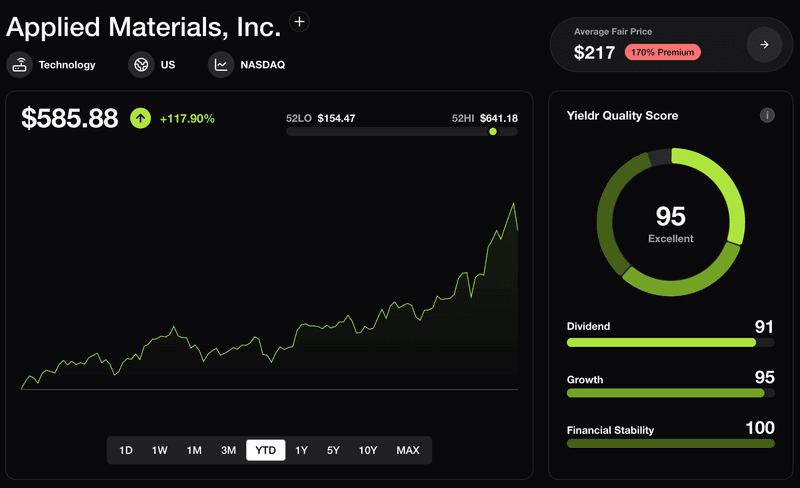
To understand how these ten signs materialize in the real market, look directly at the semiconductor equipment leader, Applied Materials (AMAT), using the live dashboard metrics from the Yieldr Stock Analyzer Tool.
Why AMAT Matches the High-Quality Blueprint:
- The Moat: Applied Materials does not design chips; it builds the highly complex materials engineering systems, software, and tools required to make chip fabrication possible. This cements them at the core of the global AI expansion.
- Pricing Power & Profitability: In their recent Q2 2026 earnings release, AMAT showcased a powerful 49.9% GAAP gross margin and a 31.9% operating margin, highlighting absolute corporate pricing leverage.
- Shareholder Returns: AMAT recently raised its quarterly cash dividend by 15% (from $0.46 to $0.53 per share), building on their eight consecutive years of growth and more than doubling its payout over a 4-year stretch.
- The Valuation Warning: While AMAT boasts a stellar operational profile, its stock market price sits at $585.88, presenting a 170% Premium to its evaluated Average Fair Price of $217. This perfectly illustrates why a high-quality asset must be paired with valuation patience.
Case Study 2: Intuit Inc. (INTU)
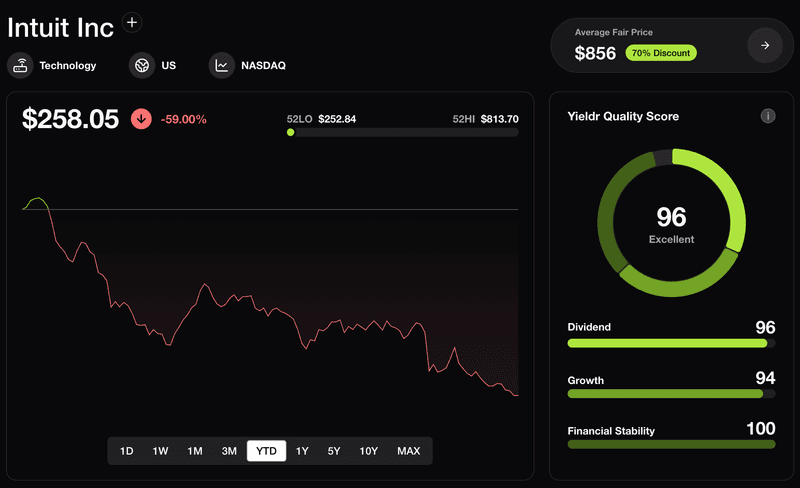
For a case study focusing on massive technological inflections and deep ecosystem moats, look at global fintech leader Intuit Inc. (INTU).
Why INTU Matches the High-Quality Blueprint:
- The Moat: Intuit controls the proprietary financial operating software standard for small businesses, accountants, and individuals through QuickBooks, TurboTax, and its scaling Intuit Enterprise Suite ecosystem.
- Highly Compounding Growth: In Q3 2026, Intuit grew its total top-line revenue by 10% to $8.6 billion, fueled by a powerful 19% spike in its Online Ecosystem revenue. The firm raised its full-year fiscal 2026 revenue growth guidance to 13%–14%, earning a top-tier Yieldr Growth Score.
- Pristine Return on Capital: Driven by high software margins, Intuit's twelve-month Return on Invested Capital (ROIC) stands at a robust 17.0%, comfortably matching our quality threshold.
- Fortress Capital Deployment: Demonstrating true financial stability, Intuit holds a liquid balance sheet with $6.8 billion in total cash and investments. Alongside a continuous $8 billion share repurchase program, the firm authorized a substantial 15% quarterly dividend increase to $1.20 per share.
Case Study 3: FactSet Research Systems (FDS)
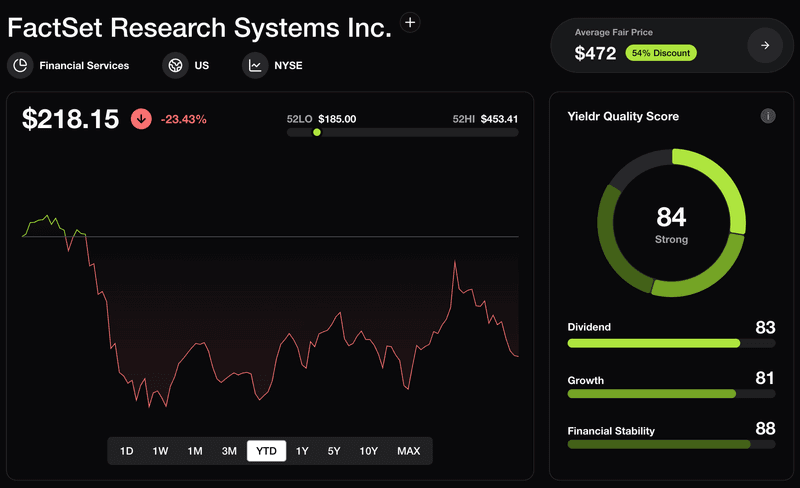
Another prime example of structural high-quality metrics is FactSet Research Systems (FDS), an indispensable workflow and data architecture provider for global financial institutions.
Why FDS Matches the High-Quality Blueprint:
- The Moat: FactSet provides the data backbones, real-time analytics, and workstation software solutions used by institutional buy-side, wealth managers, and asset management teams globally. This deep operational integration creates immense switching costs, yielding an exceptional annual business subscription retention rate of over 95%.
- Pricing Power & Profitability: Highlighting outstanding corporate pricing leverage, FactSet reported an adjusted operating margin of 35.0% for Q2 2026.
- Sustained Return on Capital: FDS consistently hits high efficiency metrics, boasting a 16.8% Return on Invested Capital (ROIC) over the last twelve months.
- Shareholder Returns: FactSet is dedicated to compounding capital distributions. Backed by expanding operating cash flows, the firm drove a 23.6% increase in free cash flow ($185.7 million) in its recent fiscal quarter, paired with proactive share buybacks and persistent long-term dividend hikes.
The Takeaway for Intentional Investors
The secret to superior long-term performance is avoiding emotional reactions to market volatility. By mapping your watchlist against objective targets, robust return on capital, fortress balance sheets, and a healthy margin of safety, you can step away from speculative trading and shift your focus onto structural compounding.
Use platforms like the Yieldr Stock Analyzer to run your holdings through these quantitative filters. When you identify a business that ticks all ten checkmarks, you aren't just buying a moving ticker symbol, you are owning a piece of a high-quality business machine.