Longacres Finance
SCHD vs VOO: Which ETF Is Better for Long-Term Investors?
SCHD or VOO? Both are outstanding ETFs, but they take very different approaches to building wealth. In this guide, we compare dividends, growth, volatility, diversification, and long-term returns to help you decide which fund best fits your investing goals.
For long-term investors, few ETF comparisons are discussed more often than SCHD vs VOO.
Both funds are extremely popular. Both have low fees. Both are designed for long-term wealth building. Yet they approach investing in very different ways.
VOO focuses on owning the largest companies in America through the S&P 500.
SCHD focuses on high-quality dividend-paying companies with strong cash flow, profitability, and dividend growth.
So which one is better?
The truth is that both are excellent ETFs. The better choice depends on your goals, investing style, income needs, and ability to stay invested during market volatility.
Let’s break down the key differences between SCHD and VOO so you can decide which ETF best fits your portfolio.
What Is SCHD?
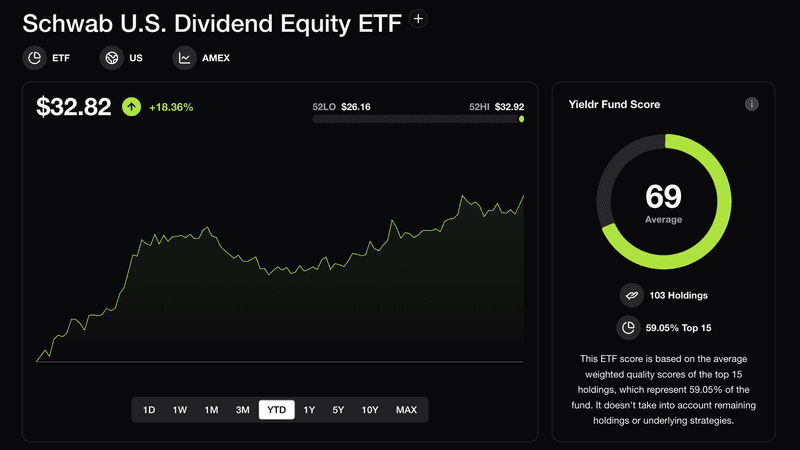
SCHD is the Schwab U.S. Dividend Equity ETF.
The fund tracks the Dow Jones U.S. Dividend 100 Index and focuses on high-quality dividend-paying companies.
To be included in SCHD, companies must meet strict financial criteria including:
- Strong return on equity
- Consistent dividend payments
- Healthy cash flow
- Sustainable dividend payouts
- Strong dividend growth characteristics
SCHD typically holds around 100 companies and leans heavily toward mature, profitable businesses.
Some of SCHD’s largest sectors include:
- Financials
- Industrials
- Consumer Staples
- Healthcare
- Energy
SCHD is especially popular among dividend growth investors because it combines:
- Solid dividend yield
- Strong dividend growth
- Quality-focused screening
- Low expense ratio
Many investors view SCHD as one of the best dividend ETFs ever created.

What Is VOO?
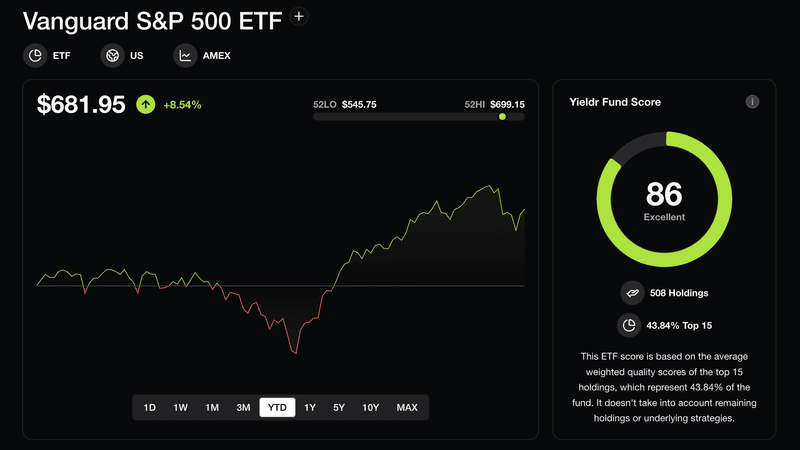
VOO is the Vanguard S&P 500 ETF.
The fund tracks the S&P 500 Index, which includes 500 of the largest publicly traded companies in the United States.
VOO gives investors broad exposure to the U.S. stock market and is often considered one of the simplest ways to build long-term wealth.
Unlike SCHD, VOO is not focused on dividends.
Instead, it focuses on overall market exposure.
Its largest holdings are dominated by mega-cap technology companies such as:
- Apple
- Microsoft
- Nvidia
- Amazon
- Meta
Because of its heavy exposure to large growth companies, VOO has benefited tremendously from the technology boom over the last decade.
VOO is widely considered one of the best “set it and forget it” investments for long-term investors.

SCHD vs VOO: Key Differences
1. Dividend Yield
One of the biggest differences between SCHD and VOO is dividend income.
SCHD generally offers a much higher dividend yield than VOO.
Historically:
- SCHD yield: around 3%–4%
- VOO yield: around 1%–1.5%
For investors focused on passive income, SCHD has a clear advantage.
However, yield alone does not determine total returns.
Many investors make the mistake of chasing high yield while ignoring growth.
The best long-term investments typically combine both income and earnings growth.
That’s where SCHD becomes particularly interesting.
2. Growth Exposure
VOO has significantly more exposure to high-growth technology companies.
This has helped VOO outperform many dividend-focused ETFs during periods when technology stocks dominate the market.
SCHD, meanwhile, focuses more on profitability, cash flow, and shareholder returns.
As a result:
- VOO may outperform during strong bull markets led by growth stocks
- SCHD may hold up better during periods of market volatility
Neither approach is inherently better.
They simply behave differently depending on market conditions.
3. Volatility
SCHD is often viewed as slightly less volatile than VOO.
That’s because SCHD avoids many speculative or unprofitable companies and instead focuses on financially stable businesses.
Dividend-paying companies also tend to be more mature and predictable.
For some investors, this makes SCHD psychologically easier to hold during market downturns.
And that matters more than most people realize.
The biggest mistake investors make is not choosing the wrong ETF.
It’s abandoning their strategy during periods of fear and uncertainty.
An investment strategy only works if you can stick with it long enough for compounding to work.
4. Diversification
VOO is more diversified than SCHD.
VOO owns 500 companies across nearly every major sector of the U.S. economy.
SCHD owns roughly 100 companies and has larger sector concentration.
This means SCHD can sometimes experience larger swings depending on how dividend-focused sectors perform.
VOO’s broader diversification makes it a more “complete” representation of the U.S. stock market.
Historical Performance
Over long periods of time, both SCHD and VOO have delivered strong returns.
VOO has generally outperformed in recent years due to the massive rally in mega-cap technology stocks.
However, SCHD has remained highly competitive while also providing significantly more income.
Importantly, investors should avoid focusing too heavily on short-term performance comparisons.
Market leadership changes constantly.
There have been periods where dividend stocks outperform growth stocks and vice versa.
The ETF that performed best over the last five years may not be the ETF that performs best over the next five years.
Long-term investing requires patience and consistency.
Which ETF Is Better for Passive Income?
If your goal is generating passive income, SCHD is likely the better choice.
SCHD offers:
- Higher starting yield
- Strong dividend growth
- High-quality companies
- Better income generation
Many investors use SCHD as a core income-producing position in retirement portfolios.
The higher yield can also help investors psychologically stay invested because they continue receiving cash flow even during market downturns.
Which ETF Is Better for Maximum Growth?
If your goal is maximizing long-term capital appreciation, VOO may have the edge.
VOO gives investors greater exposure to:
- High-growth technology companies
- Market-leading innovators
- Broad economic growth
Historically, the S&P 500 has been one of the greatest wealth-building tools ever created.
For younger investors with long time horizons, VOO may provide slightly stronger long-term growth potential.
Why Many Investors Own Both
The good news is investors do not necessarily need to choose between SCHD and VOO.
Many long-term investors combine both ETFs.
For example:
- VOO provides broad market growth exposure
- SCHD provides income and dividend growth
Together, they can complement each other extremely well.
This combination allows investors to benefit from:
- Strong long-term market returns
- Growing passive income
- Diversification across investment styles
- Reduced dependence on a single sector
For many investors, owning both may actually be the best solution.
SCHD vs VOO: Final Thoughts
SCHD and VOO are both outstanding long-term investments.
Neither ETF is “better” in every situation.
The better choice depends on your goals.
Choose SCHD if you prioritize:
- Passive income
- Dividend growth
- Quality companies
- Lower volatility
Choose VOO if you prioritize:
- Broad market exposure
- Maximum long-term growth
- Simplicity
- Technology exposure
Most importantly, remember this:
Your long-term success will likely depend less on whether you choose SCHD or VOO and more on whether you consistently invest, reinvest dividends, and stay patient through market volatility.
Compounding only works if you give it time.