Longacres Finance
How to Analyze a Dividend Stock: A 3-Step Framework Using Rollins as a Case Study
Is Rollins (ROL) a high-quality business, a stock worth owning, and an attractive investment today? I analyze its fundamentals, dividend, recent earnings, valuation, and future return potential to find out.
When analyzing a stock, it can be tempting to start with one simple question:
Is it cheap?
But valuation should not be the first question you ask.
A stock can look cheap and still be a terrible investment. A declining business, excessive debt, weak cash flow, or an unsustainable dividend can make even a seemingly attractive valuation a value trap.
Instead, I believe a better approach is to work through three questions:
- Is this a high-quality business?
- Is this a company I actually want to own?
- Is the stock an attractive opportunity today?
This framework separates business quality from valuation and helps prevent investors from allowing a low stock price to influence their opinion of the underlying company.
To demonstrate how this works, let's apply the framework to Rollins (ROL), one of the largest pest control companies in the world.
If you'd prefer to listen to this breakdown you can watch this video on Yieldr's Youtube channel.
Disclosure: I currently own shares of Rollins. At the time of writing, my position was approximately 227 shares with a market value of roughly $8,500. This represented about 1.67% of my portfolio. I was down approximately 21% on the position, while the position was projected to generate roughly $165 in annual dividend income over the next 12 months.

Step 1: Is Rollins a High-Quality Business?
The first question isn't about the stock price.
It's about the business.
One of the quickest ways to get an initial read on a company is to look at its Yieldr Quality Score.
Rollins currently has a Quality Score of 92 out of 100, which falls into the excellent category.
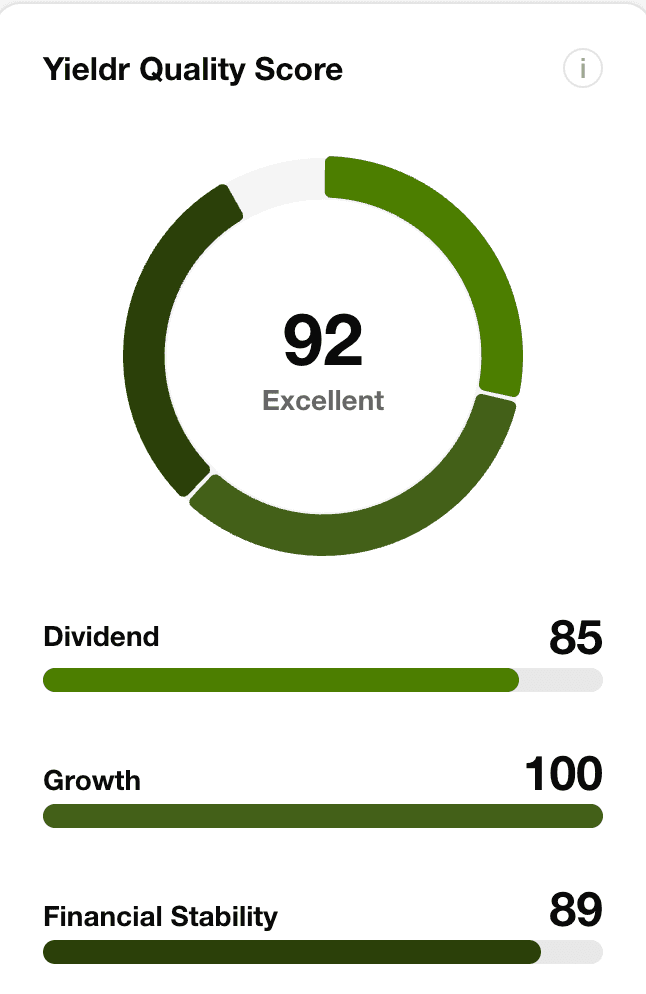
The score is made up of three components:
- Dividend Profile: 85/100
- Growth Profile: 100/100
- Financial Stability: 89/100
That gives us a strong initial indication that Rollins has many of the characteristics I look for in a high-quality dividend business.
But a score is only a starting point. Let's dig into the underlying fundamentals.
Strong Free Cash Flow Growth
One of the first metrics I like to examine is free cash flow per share.
Free cash flow is one of the most important measures of a company's financial health because businesses ultimately need cash to fund operations, invest in growth, pay down debt, make acquisitions, and return capital to shareholders.
Rollins has produced a particularly attractive long-term trend in free cash flow per share.
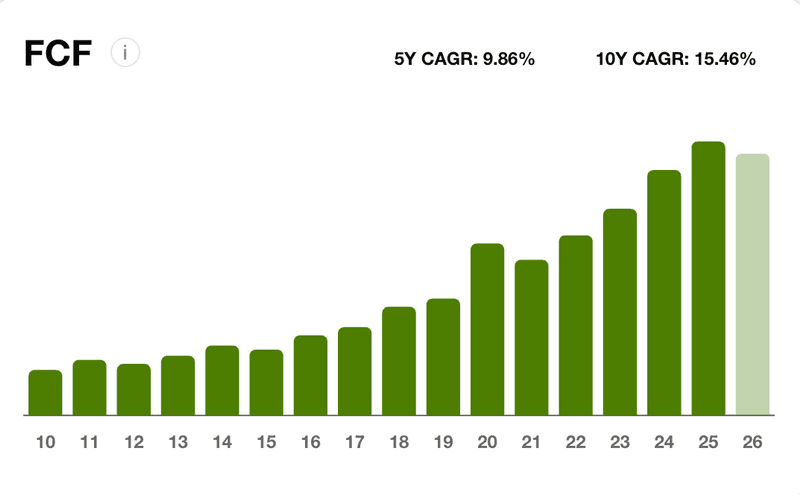
Over the past decade, free cash flow per share has grown at a 15.46% CAGR.
The five-year CAGR is lower, but still impressive at approximately 9.86%.
Even more importantly, the long-term trend has been relatively consistent.
Rollins grew free cash flow per share from approximately $0.22 in 2010 to $1.34 in 2025.
That's roughly a six-fold increase over 15 years.
For a mature company, that's an impressive rate of cash-flow growth.
High Returns on Invested Capital
Free cash flow tells us how much cash a business generates.
But another important question is:
How effectively can the company reinvest that cash?
That's where Return on Invested Capital, or ROIC, becomes useful.
ROIC measures how effectively a company generates profits from the capital invested in the business.
I consider a ROIC above 20% to be excellent.
Rollins currently has a ROIC of approximately 20.1%, right around that threshold.
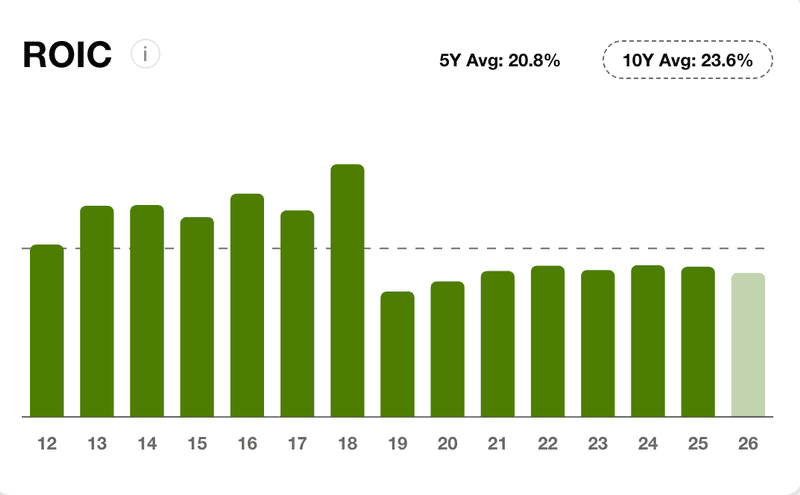
Its 10-year average is even stronger at approximately 23.6%.
There was a period between roughly 2012 and 2018 when Rollins consistently generated ROIC close to or above 30%.
While I would obviously prefer to see ROIC remain closer to 30% indefinitely, maintaining profitability above 20% is still very attractive.
And there's an important connection between ROIC and free cash flow.
A company generating significant free cash flow is attractive.
A company that can then reinvest that cash at high rates of return is even more attractive.
Rollins appears capable of doing both.
Healthy Profit Margins
The next thing I like to examine is the company's margin profile.
Rollins currently has approximately:
- 50% gross margin
- 18.7% operating margin
- 13.5% net margin
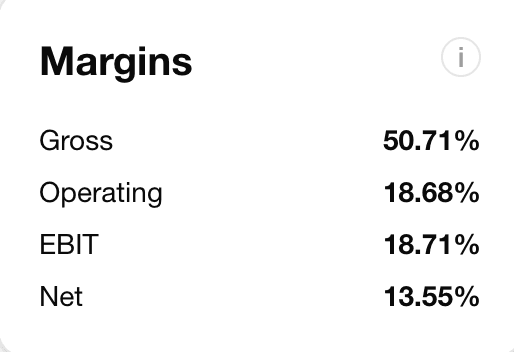
These are strong margins for a pest control company.
The gross margin tells us that Rollins retains roughly half of its revenue after direct costs.
An operating margin approaching 19% indicates that a substantial portion of revenue remains after operating expenses.
And a net margin of approximately 13.5% means the company ultimately converts roughly $0.14 of every $1 in revenue into net income.
Taken together, the picture is compelling:
Rollins generates strong free cash flow, has high returns on invested capital, and operates with healthy margins.
Now let's look at the balance sheet.
Financial Stability: Can Rollins Handle Its Debt?
A great business can still become a poor investment if it takes on too much debt.
Two metrics I like to examine are:
- Free Cash Flow / Total Debt
- Interest Coverage
The first tells us how much debt a company could theoretically pay down using its annual free cash flow.
The second tells us how comfortably the company's earnings cover its interest expense.
Rollins currently generates approximately $0.56 of free cash flow for every $1 of total debt.
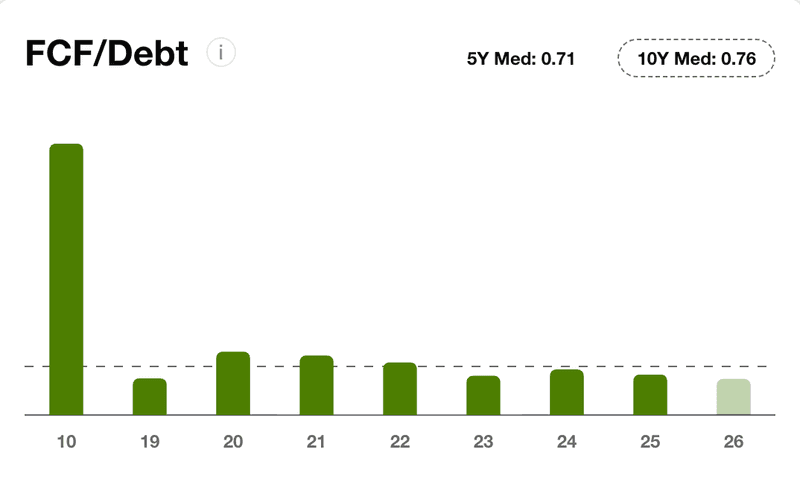
In other words, its annual free cash flow is equivalent to approximately 56% of total debt.
I generally consider 30% or higher to be a strong result.
At its current rate of cash generation, Rollins could theoretically pay off all of its outstanding debt in less than two years if it directed essentially all of its free cash flow toward debt repayment.
Its interest coverage ratio of approximately 21.8x is also excellent.
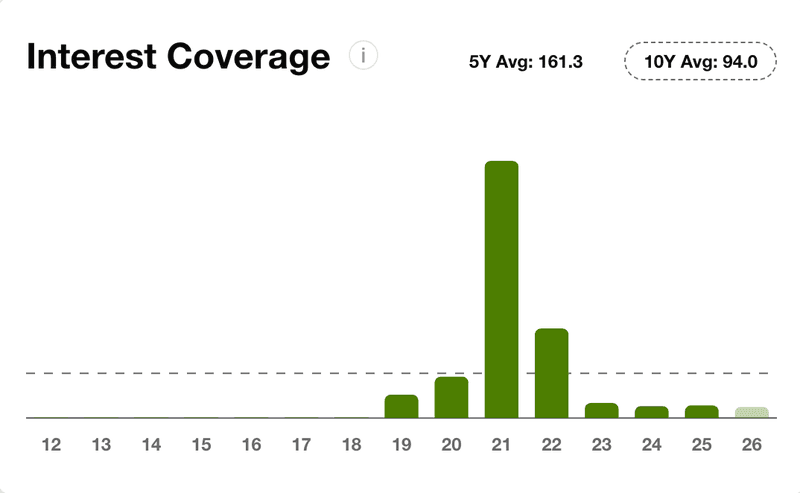
I generally consider 10x or higher to be very strong.
At more than twice that level, Rollins appears to have substantial room to comfortably service its debt.
So far, the picture looks very good:
Strong growth. High profitability. Healthy margins. Strong cash generation. And manageable debt.
That's exactly the type of business I'm looking for.
What About the Dividend?
Notice that I intentionally saved the dividend profile for last.
That's because I don't want a high dividend yield to convince me that a company is worth owning before I've established that the underlying business is attractive.
If the business fundamentals don't meet my expectations, there's little reason to spend much time analyzing the dividend.
With Rollins, however, the dividend profile is also compelling.

The forward dividend yield is approximately 1.93%.
That isn't a high yield in absolute terms, but it is attractive relative to the broader quality-growth dividend universe, and especially compared with the roughly 1.37% yield of my overall portfolio.
The current payout ratio is approximately 64.5%.
I'd prefer a somewhat lower payout ratio, but the historical context makes this figure more reassuring.
Rollins has maintained a payout ratio around 60–65% for much of the past decade, with the 10-year average sitting at approximately 63.8%.
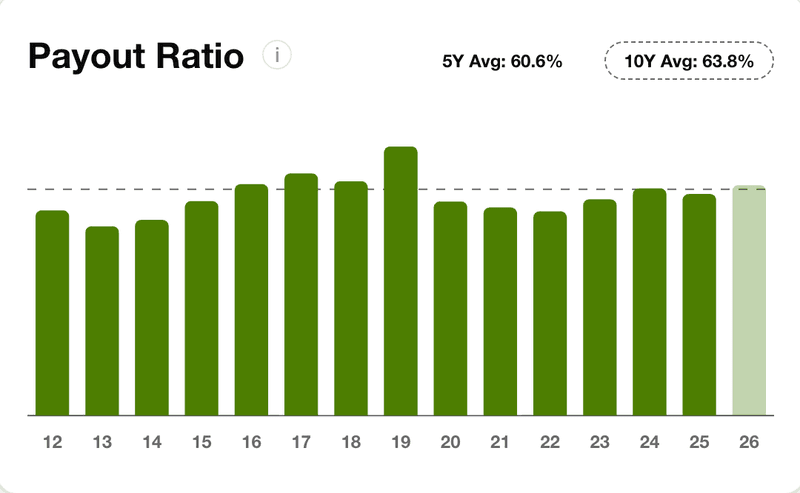
That consistency is important.
The company isn't suddenly paying out a dramatically larger percentage of its earnings simply because earnings have weakened.
Instead, the current payout ratio is broadly consistent with its historical range.
A Strong Dividend Growth Track Record
Rollins also has a dividend growth streak spanning more than two decades.
Even more impressive is the pace of that growth.
Its approximate dividend growth rates are:
- 1-year: 10.16%
- 5-year CAGR: 23.07%
- 10-year CAGR: 16.89%
The growth rate has slowed over time, but double-digit dividend growth is still an excellent result.
The company's most recent dividend increase, announced in October 2025, was approximately 10.61%.
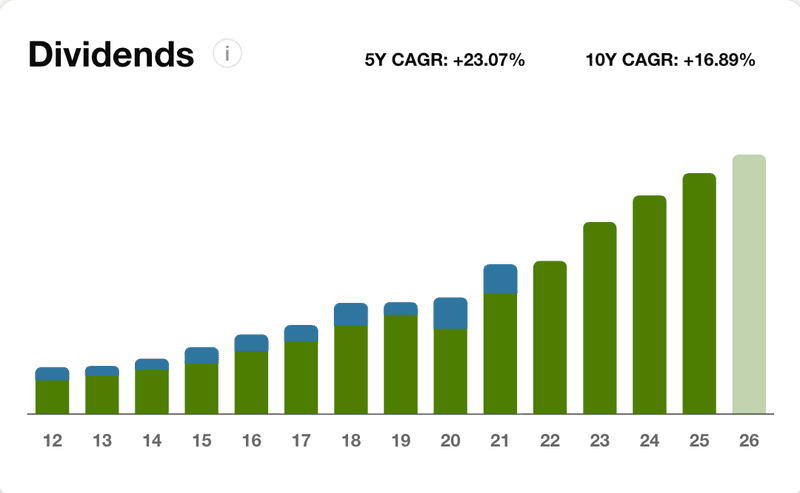
Rollins also historically paid special dividends, although those payments have stopped in recent years.
Importantly, the regular dividend has continued to grow at a healthy rate even without those special distributions.
When you combine a roughly 2% starting yield, a payout ratio around 65%, and a long history of double-digit dividend growth, the dividend profile looks quite attractive.
At this point, I'm comfortable answering the first question:
Is Rollins a high-quality business?
Yes.
The company has strong cash-flow growth, high returns on invested capital, healthy margins, manageable debt, and an attractive dividend growth history.
But quality alone isn't enough.
Step 2: Is Rollins a Business I Actually Want to Own?
This is a slightly different question.
You might think that if a company is high quality, you automatically want to own it.
Not necessarily.
Before investing, I want to understand what the company actually does, whether I believe the business model is sustainable, and whether I believe there are opportunities for the company to continue growing.
Is the Business Easy to Understand?
For me, Rollins passes this test easily.
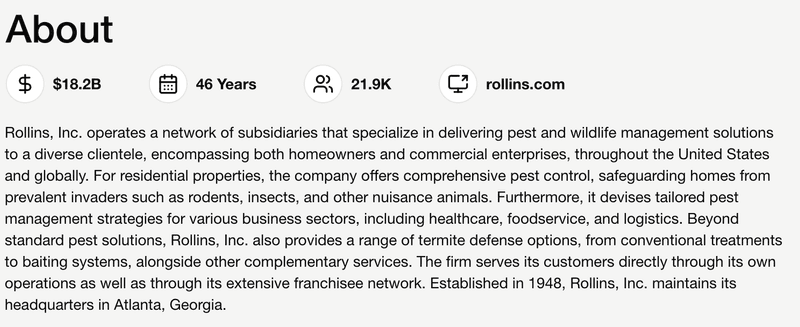
The company operates a network of subsidiaries providing pest and wildlife management services to residential and commercial customers.
In simpler terms:
Rollins is a pest control company.
That's a business I can understand.
And the underlying demand is fairly easy to understand as well.
Pests aren't going away.
Homeowners don't want termites, ants, rodents, mosquitoes, or other pests in their homes.
Businesses don't want them either.
Restaurants, hotels, offices, warehouses, and other commercial properties often need pest control services to protect their facilities, customers, employees, and reputations.
And pest control isn't necessarily a one-time purchase.
Many customers sign up for recurring service plans where technicians regularly treat the property to prevent problems from returning.
That creates a valuable combination:
Recurring revenue + essential services + repeat demand.
Is the Business Sustainable?
I believe it is.
Pest problems are difficult to eliminate permanently.
Even after a property has been treated, pests can return.
That creates an ongoing need for preventative maintenance.
This gives Rollins the opportunity to establish long-term customer relationships rather than constantly finding new customers to replace old ones.
The company's size also gives it another potential growth avenue.
With a market capitalization of roughly $18 billion, Rollins has the scale to continue acquiring smaller pest control businesses and integrating them into its platform.
That acquisition strategy has been an important part of the company's growth.
So I believe Rollins has several avenues to grow:
- Organic customer growth
- Pricing
- Recurring service revenue
- Cross-selling
- Geographic expansion
- Acquisitions
That makes Rollins a business I would actually want to own.
But let's see whether the company's recent results support that thesis.
A Look at Rollins' Latest Results
Rollins' second-quarter results provide a useful snapshot of how the business is performing.
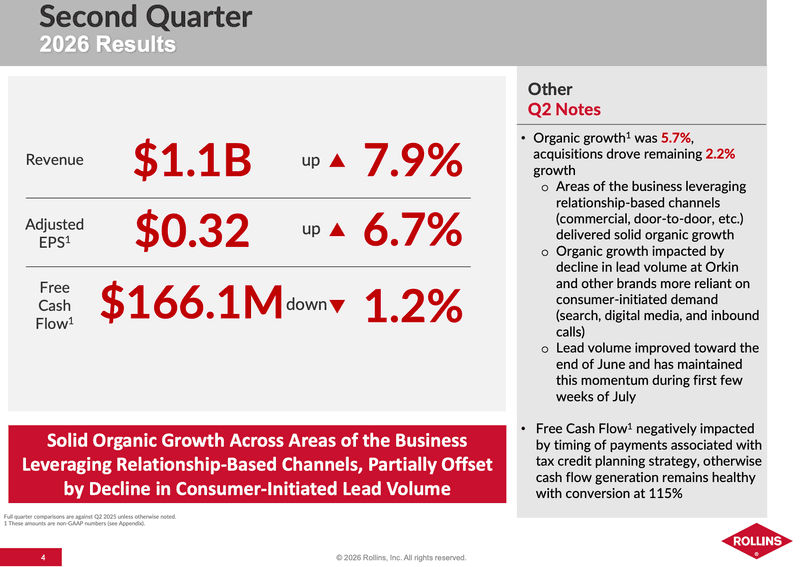
Quarterly revenue increased approximately 7.9% year over year.
Organic growth contributed about 5.7%, while acquisitions contributed another 2.2%.
That's a healthy combination of organic and acquisition-driven growth.
Earnings per share increased approximately 6.7%.
Free cash flow, however, declined about 1.2%.
At first glance, that might look concerning.
But the company's explanation is important.
Free cash flow was negatively affected by the timing of payments associated with its tax credit planning strategy.
Excluding that timing impact, cash flow generation remained healthy, with free cash flow conversion reaching approximately 115%.
This is a good example of why it's important to investigate the reason behind a change in a financial metric rather than simply reacting to the headline number.
Growth Across the Business
Rollins' three major segments; Residential, Commercial, and Termite, each generated both organic and acquisition-related revenue growth.
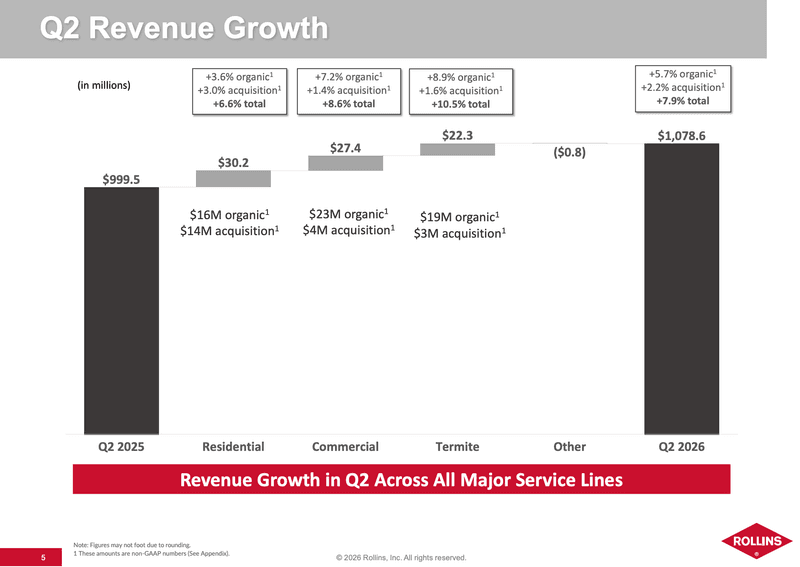
That's encouraging because the company's growth isn't dependent on a single segment.
There was some pressure on EBITDA margins, which declined approximately 1.2 percentage points.
Management attributed the pressure to factors including lower volume, higher medical-related costs, and fuel headwinds.
Those aren't ideal developments, but they also don't necessarily appear to represent a structural deterioration of the business.
More importantly, management's longer-term outlook remains attractive.
Rollins' Long-Term Growth Opportunity
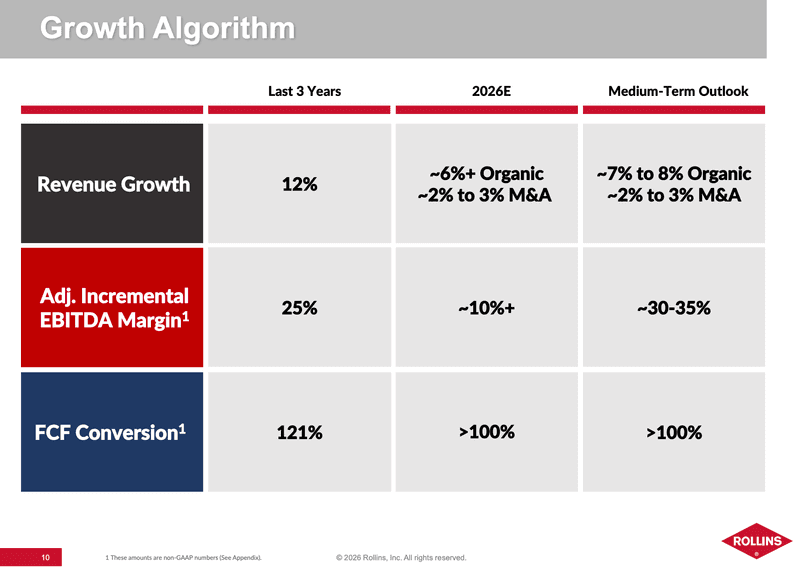
Over the previous three years, Rollins reported approximately:
- 12% annual revenue growth
- 25% EBITDA margin
- 121% free cash flow conversion
The 2026 outlook is somewhat weaker, with revenue growth expected around 8–9%, depending on the level of M&A.
However, management's mid-term outlook remains quite compelling.
The company expects:
- 9–11% revenue growth
- Significant margin expansion
- 30–35% margins
- Free cash flow conversion above 100%
If Rollins can achieve those targets, the company could continue producing strong cash-flow growth well into the future.
That brings us to the final question.
Step 3: Is Rollins an Attractive Opportunity Today?
Now, and only now, do I want to look at valuation.
Rollins has experienced a significant decline in its stock price.
The shares peaked around $65 in February 2026 before falling to approximately $38.
That's a substantial decline.
And according to three different Yieldr valuation models; P/E, free cash flow, and Dividend Yield Theory, the stock appears to be trading at approximately a 34% discount to fair value.
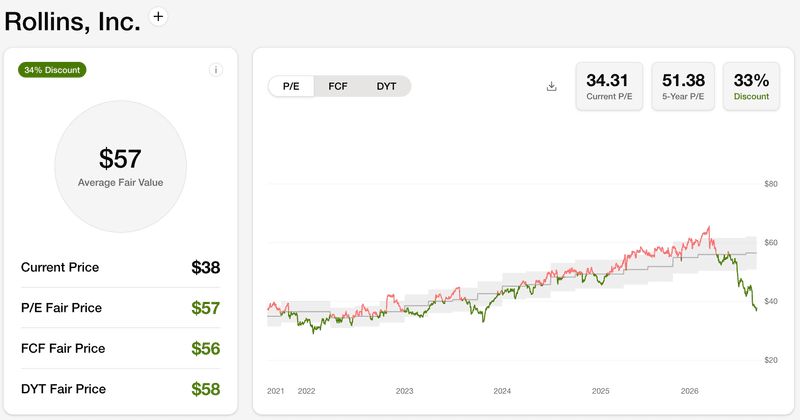
Interestingly, all three models arrive at a similar fair value of approximately $57 per share.
That consistency gives me more confidence than relying on a single valuation methodology.
But there is an important caveat.
Cheap Relative to History Doesn't Mean Cheap in Absolute Terms
At approximately $38 per share, Rollins trades at roughly:
- 34x earnings
- 29x free cash flow
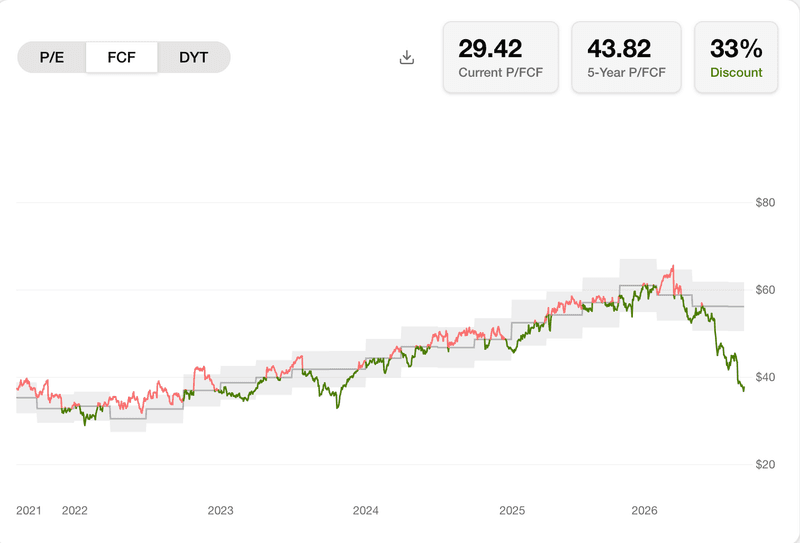
Those aren't objectively low multiples.
For comparison, long-term market averages for these ratios are closer to 15x.
So why does Rollins appear undervalued?
Because the market has historically been willing to pay a substantial premium for this business.
Over the past decade, Rollins has frequently traded at a P/E ratio above 40, and sometimes closer to 50.
Its price-to-free-cash-flow ratio has also frequently been above 40.
So today's valuation looks much more attractive relative to Rollins' own history than it does relative to the broader market.
That's an important distinction.
A stock can be historically cheap without being traditionally "cheap."
And that's exactly how I view Rollins today.
Dividend Yield Provides Another Valuation Signal
The dividend yield tells a similar story.
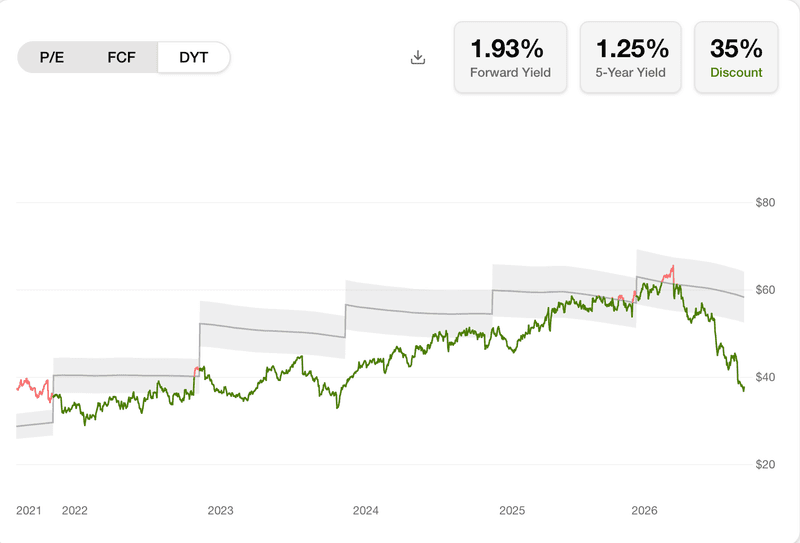
At approximately 1.93%, Rollins' current yield is among the highest it has offered since 2017.
The five-year average yield is only about 1.25%.
That means today's yield is approximately 35% higher than its five-year average.
Dividend Yield Theory essentially tells us that if the underlying business remains relatively similar, an unusually high yield can indicate that the stock price has become relatively inexpensive.
That doesn't guarantee the stock will rise.
But combined with the other valuation methods, it adds another piece of evidence that the current price may represent an attractive opportunity.
Estimating Rollins' Future Return Potential
I don't like to make precise predictions about where a stock will trade five years from now.
But I do think it's useful to estimate potential returns based on reasonable assumptions.
For me, there are three primary drivers of long-term stock returns:
- Starting dividend yield
- Business growth
- Valuation expansion or contraction
Let's run through them.
1. Dividend Yield
The current forward dividend yield is approximately 1.93%.
That's our starting point.
2. Valuation Expansion
If Rollins' fair value is approximately $57 and the current stock price is around $38, the shares would need to rise approximately 50% to reach that fair value.
Obviously, I wouldn't expect that to happen overnight.
If we assume that the valuation gradually returns to fair value over five years, the annualized contribution from valuation expansion would be approximately 8.45% per year.
3. Business Growth
The final component is business growth.
Current analyst consensus calls for approximately 9% annual earnings growth over the next several years.
Combining these three potential sources of return:
- 1.93% dividend yield
- 8.45% annualized valuation expansion
- 8.97% business growth
= approximately 19.35% annual return potential
That's obviously an estimate, not a prediction.
It depends on three major assumptions:
- Rollins continues growing at roughly 9% annually.
- The stock eventually returns to the estimated fair value.
- The current valuation models are reasonably accurate.
All three could be wrong.
And that's exactly why I like to think about margin of safety.
What If the Valuation Is Completely Wrong?
Let's assume the valuation models are wrong.
Let's assume Rollins never returns to $57.
In that scenario, we eliminate the entire valuation expansion component.
We're left with approximately:
1.93% dividend yield + 8.97% business growth = roughly 11% annual return potential.
That's still close to my long-term target of approximately 12% annual returns.
In other words, I don't need everything to go right for Rollins to potentially generate an attractive return from today's price.
That's an important part of the investment thesis.
The Final Verdict on Rollins
Let's return to the three questions we started with.
1. Is Rollins a high-quality business?
Yes.
Rollins has:
- Strong free cash flow growth
- High ROIC
- Healthy profit margins
- Strong interest coverage
- Manageable debt
- A long dividend growth history
- Double-digit historical dividend growth
2. Is Rollins a business I actually want to own?
Yes.
The business is easy to understand, provides an essential recurring service, benefits from durable demand, and has multiple opportunities for future growth through organic expansion and acquisitions.
3. Is Rollins an attractive opportunity today?
I believe so.
The stock appears inexpensive relative to its own historical valuation, its current dividend yield is unusually attractive, and the estimated future return potential is well above my long-term target.
There is also a reasonable margin of safety if the valuation assumptions prove to be overly optimistic.
That doesn't mean Rollins is without risk.
The stock still trades at a relatively high absolute valuation, margins have experienced some recent pressure, and the company will need to continue executing well to justify its premium valuation.
But at approximately $38 per share, I believe the risk/reward profile has become increasingly attractive.
I would be comfortable adding to my position at this price.
Analyze Stocks Like This With Yieldr
If you'd like to apply this framework to your own investments, Yieldr brings many of these tools together in one place.
You can research individual stocks, analyze your portfolio, evaluate valuation, review quality metrics, project future dividend income, and discover potential investment ideas.
Yieldr also includes the Quality Score, valuation models and let's you analyze over 70,000 global stocks.